
SHAYNA COOK, ABBIE LIEBERMAN 02/28/2017
Shayna Cook is Policy Analyst, Education Policy Program at New America.
Abbie Lieberman is Policy Analyst, Education Policy Program at New America.
Ms. Paredes glances at her watch. Today, the principal will visit the class for the first time this year. As she settles the children on the carpet for a read aloud using How Many Stars in the Sky?, by Lenny Hort, Principal Murin walks in and takes his seat. The story ends and the children discuss their favorite parts with a partner. Then Ms. Paredes and her assistant begin a “Twinkle, Twinkle, Little Star” fingerplay. After that, children choose their learning centers, and Ms. Paredes circulates.
Principal Murin observes her in the science center. Two girls and a boy take an empty box and imagine that they are in a rocket ship going to the moon. Ms. Paredes asks encouraging questions like, “Where else could you go in space?” and “How will you stay seated in the rocket with no gravity?” Ms. Paredes is excited to see the children’s engagement and to hear them think about answers to the questions.
When the observation period ends, though, Principal Murin leaves the classroom confused. He appreciated the children’s engagement with the science center but wonders why such a structured lesson ended up with the children “just” playing.
This scenario is all too common. Elementary school principals don’t always recognize how much children learn through play. In fact, play is a vehicle for student-centered learning, allowing meaningful interactions and conversation. Guided play helps children learn to solve problems, persist through challenges, build vocabulary skills, and gain background knowledge in many content areas. Many studies show the value of play-based learning. Yet it is far too rare in the early grades.
We authors work at New America, a DC think tank. Last year, our Early and Elementary Education Policy team convened five focus groups of elementary school principals around the country to explore their perceptions of what instruction should look like in pre-K through third grade classrooms. The groups answered questions on staffing, student transition from pre-K to kindergarten, student assessment, professional development, and the role of a principal. We compiled our findings into a series of briefs called Principal’s Corner: Perspectives on Teaching and Learning Pre-K–3rd Grade.
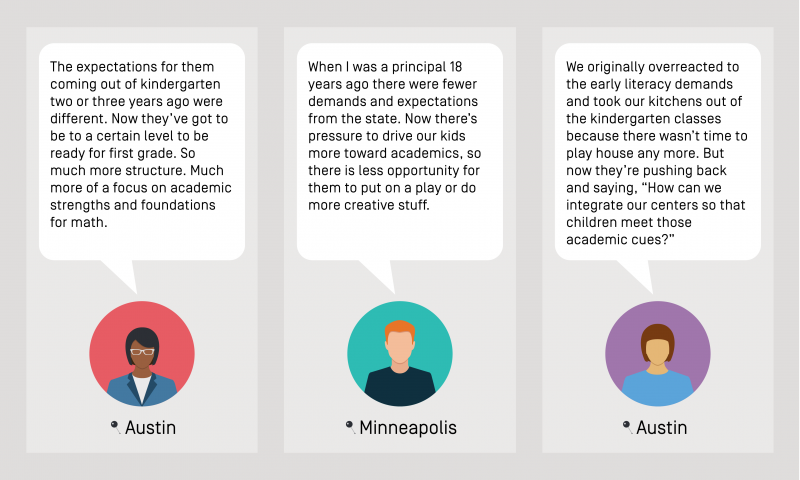
Principals in our groups had different opinions about the characteristics of strong learning environments in early childhood. Many acknowledged that play is an important teaching tool when working with young children. But the majority of principals felt pressured to limit play time in pre-K, kindergarten, and the early grades to focus on academics. In essence, they did not always make a direct connection between play and learning. Here are three examples of what they said:
Play is essential to child development. When principals and other instructional leaders are able to see what learning through play looks like in a classroom, they are better equipped to help teachers promote developmentally-informed practices.
(2017, February 28). Retrieved June 10, 2020, from https://www.naeyc.org/resources/blog/academics-vs-play
FOR FULL TEXT CLICK THE LINK ABOVE
 Makaleskop